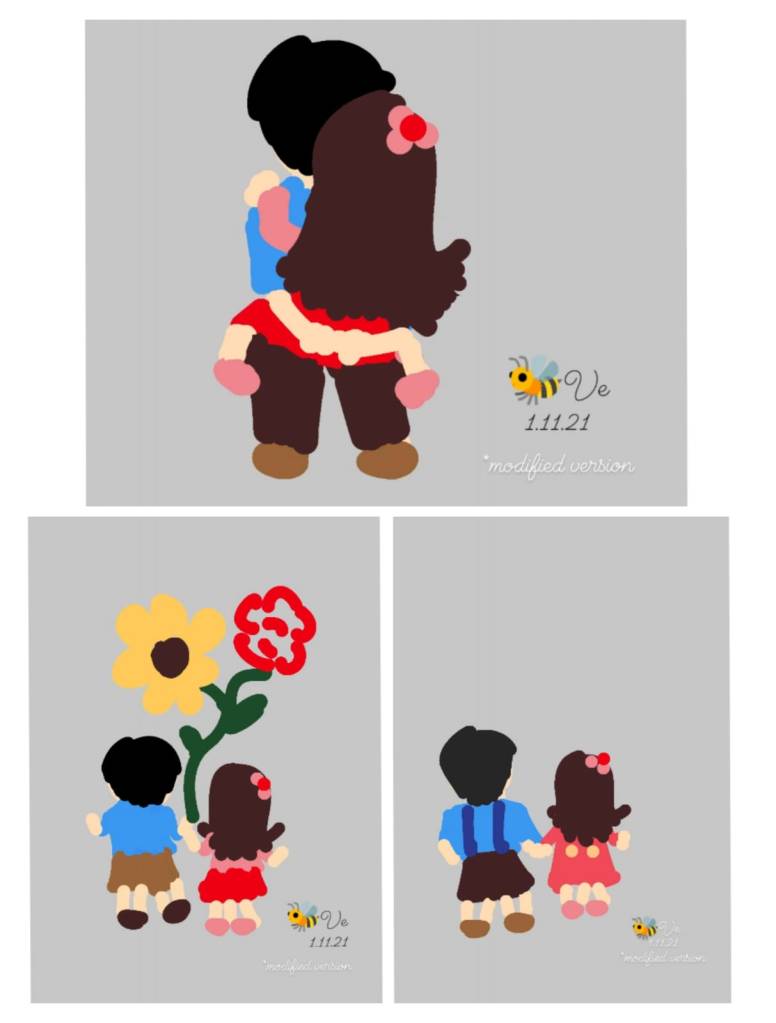
These little drawings were made years ago, almost spontaneously.
They began with something very simple: my fingers moving across a screen, putting together colours, shapes and small figures without thinking too much about whether they were beautiful, sophisticated, or even technically “good”.
Looking at them now, I can see how childlike they are.
But perhaps that was exactly what I needed.
Behind those simple shapes was a wandering soul trying to find somewhere to rest.
At that time, drawing became one small way of stretching beyond my comfort zone. I was quietly exploring what I could make, but perhaps more importantly, what I could become.
The journey was not really happening on the screen.
It was happening somewhere inside me.
I was travelling inward, sometimes towards places I had avoided for a long time—old wounds, insecurities, fears, limitations, and parts of myself that I had not yet learned how to understand.
Slowly, I began to realise that healing was not always about defeating those parts of myself. Sometimes it meant sitting beside them. Becoming familiar with my limits. Learning not to treat every vulnerability as an enemy.
And from there, taking another small step.
A little more courage.
A little more curiosity.
A little more willingness to learn about self-esteem, spirit, and the person I might still become.
Perhaps that is why I still keep these drawings.
They remind me that creativity does not always arrive as great art.
Sometimes it arrives quietly, through a finger touching a screen, a childish-looking flower, two little figures walking together, or an image created without any plan.
And somehow, those small acts can hold an entire inner journey.
These sketches may belong to another time, but the journey they witnessed still belongs to me.
They remind me that even when my soul was wandering, some part of me was already trying to find the way home.
There are moments in life that do not arrive with great announcements.
Sometimes they arrive through little feet walking across freshly worked earth.
There were many of them that morning.
Little feet, shared curiosity
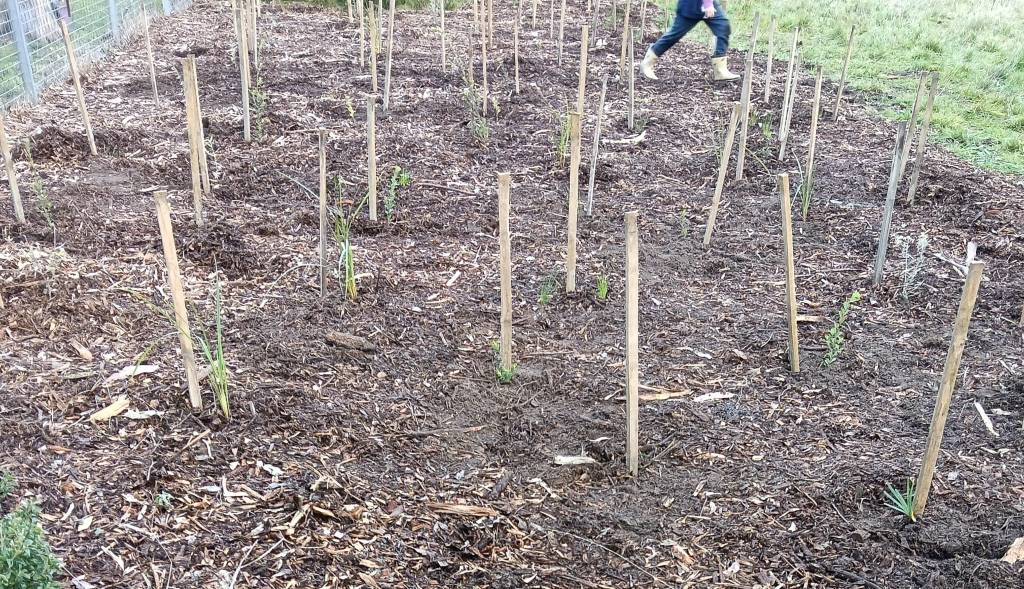
Children moved among newly planted native vegetation, each small contribution becoming part of something that may grow far beyond the morning in which it was planted.
Small boots moved between the seedlings, accompanied by giggles, questions, and the kind of curiosity children seem to carry so naturally. Together, they helped place young plants into the earth.
That morning’s Kingston Beach Coastcare working bee had been registered as part of National Tree Day. It was the first time the group had registered the activity with the event, bringing many children and families together to participate.
Looking across the planting area afterwards, I found myself thinking about how small everything looked.
Small hands. Small plants. Small individual contributions.
But meaningful ones.
And perhaps that is precisely how many meaningful things begin.
Small today, perhaps shelter tomorrow
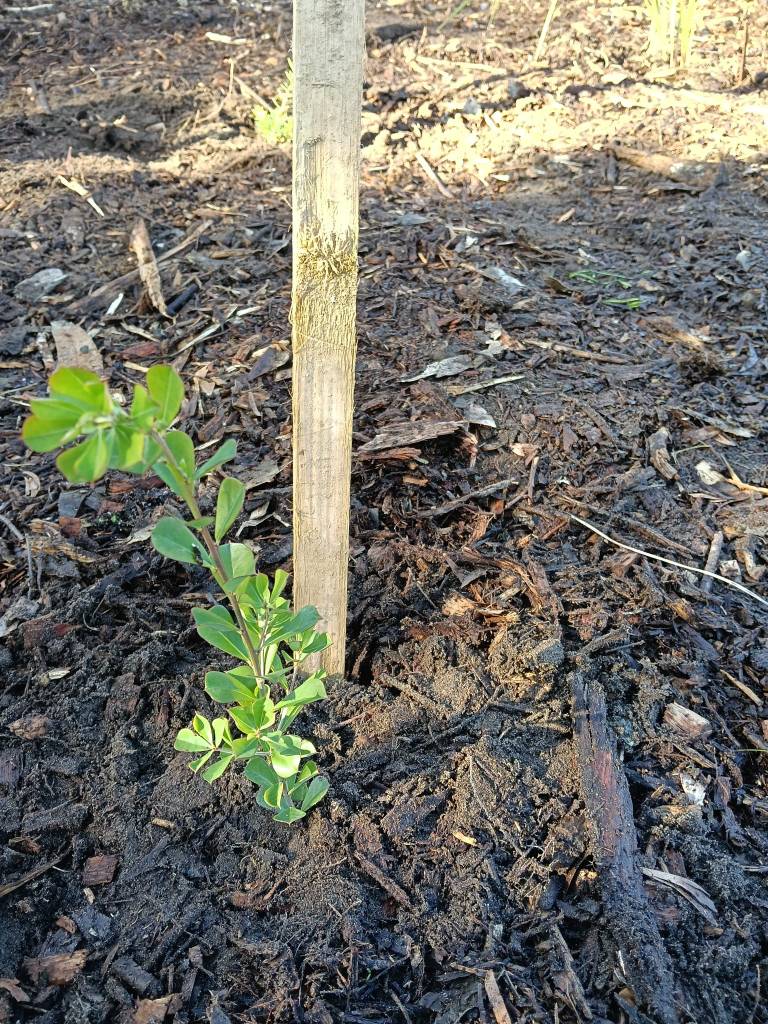
One of the young plants placed into the earth during the working bee became a quiet reminder to me that what begins small can eventually grow into something that gives back to its surroundings.
The plants in the photograph may look tiny today. But given time, care, and the opportunity to establish themselves, they can grow. Their roots may strengthen the ground beneath them. Their leaves may become part of a larger habitat.
What appears to be a very small contribution during one morning may continue giving to the environment long after those who planted it have gone home.
I think there is something about life in that.
The Things We Plant
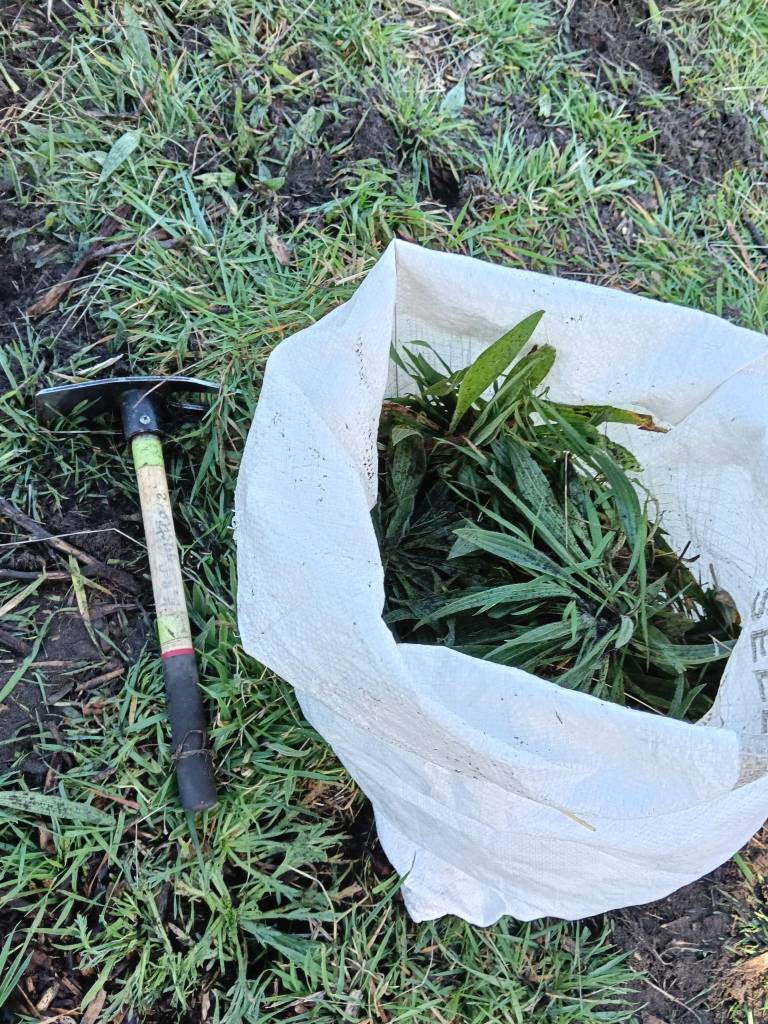
Weeding alongside other volunteers—hands, soil, conversation, and one small contribution to a much larger collective act of care.
My own task that day was mostly weeding, gathering what had been removed, and working alongside the other volunteers.
But I was also quietly observing.
I found myself noticing the people around me—the beautiful souls who had chosen to spend part of their morning contributing to this place. I was learning from them and wondering how I, too, might become more meaningful in the ways I contribute.
My hands were inside gloves, working with soil and weeds, while around me people cheerfully did what needed to be done.
There were also conversations—small exchanges, light discussions, laughter, and the easy companionship that can make a voluntary activity feel like something you would happily return to again.
And I liked that.
For a long time, much of my life seemed occupied by big things—study, responsibilities, uncertainty, plans for the future, and questions that sometimes felt larger than myself.
This small activity reminded me that contributing to life does not always have to be big.
Sometimes we simply remove one weed.
Sometimes we plant one seedling.
Sometimes we turn up.
And perhaps that is already something.
A Connection That Began Years Earlier
My connection with this activity did not begin this year.
Around 2021, Barbara Marshall, who had once been my English teacher, introduced me to Kingston Beach Coastcare.
I still like calling her my teacher.
Yes, she once helped me with English. But over the years, I began to understand that some teachers teach us far beyond the subject through which we first met them.
At that stage of my life, I was overwhelmed by many bigger things.
I joined the mailing list and quietly read the messages that arrived. I could see activities being organised and people continuing to care for the area, but I was living in another city and could contribute very little.
So mostly, I watched from a distance.
Years passed.
Eventually, I attended one of the activities for the first time.
Again, I did not do very much.
But something stayed with me.
Perhaps it was the place.
Perhaps it was the people.
Perhaps it was seeing the consistency of something continuing year after year.
Somehow, Kingston gradually became one of those places towards which life kept drawing me closer.
And eventually, life did bring me closer to this part of Tasmania than where I had lived before.
Consistency
What has stayed with me most is not one particular working bee.
It is consistency.
Over the years, I have watched my teacher remain connected with this work.
Life changes. People become busy. Circumstances shift. Energy rises and falls.
Yet some people continue showing up for the things they believe deserve care.
There is something deeply beautiful about that.
Through her example and reflections, I have also begun to understand that volunteering offers much more than the completion of practical tasks.
It can nurture relationships.
It can connect people and build networks.
It can create opportunities for leadership.
It can leave a legacy that extends beyond one person, one activity, or one season.
It can also create a sense of psychological safety—a welcoming space where people feel able to participate, ask questions, learn, contribute in their own way, and gradually develop a sense of belonging.
I once thought teachers were people who stood at the front of classrooms.
Life has gradually taught me otherwise.
Sometimes teachers are simply people whose way of living quietly asks us:
What will you contribute when you enter the next chapter of your life?
Not necessarily something enormous.
Not something that needs recognition.
Just something useful.
Something kind.
Something that leaves a place, a community, or another person slightly better than we found them.
More Than Caring for a Coast
The activity I joined was organised by Kingston Beach Coastcare.
The July 2026 working bee formed part of winter planting and native vegetation restoration at the entrance to Piramina, also known as Browns River, Saltmarsh Reserve. It was also registered as part of National Tree Day, bringing children, families, and other community members together to care for the area.
Kingston Beach Coastcare’s wider program includes planting, weeding, clean-ups, dune restoration, and other practical activities supporting the local coastal environment.
But what I am writing here is not an account on behalf of Kingston Beach Coastcare.
It is simply what I felt as one volunteer standing among plants, soil, children, tools, and other people giving some of their time.
To me, Coastcare began to mean something larger than caring for a beach.
It showed me something about caring with people.
About creating spaces where children can learn through their hands.
Where people of different ages can work alongside one another.
Where relationships can grow naturally through shared work.
Where knowledge, leadership, and responsibility can be passed quietly from one person to another.
Where people can feel welcomed and safe enough to contribute, even when they are new, uncertain, or able to offer only a small amount.
Where small actions accumulate.
Where care for nature can quietly become care for community as well.
Perhaps that is why the word care feels increasingly important to me.
Care does not always announce itself.
Often, it is simply repeated.
Again.
And again.
And again.
Until one day, what used to be a tiny plant has roots.
I Still Haven’t Done Much
I cannot say that I have contributed very much.
Not yet.
For years, I mostly read the emails.
I came once.
Then disappeared again into life.
Now I have returned, pulled some weeds, shared a little time with others, and watched children place young plants into the earth.
That is all.
But perhaps I no longer need to measure contribution only by its size.
Maybe this part of my life is teaching me to begin differently.
Quietly.
To arrive where I can.
To help where I can.
To learn from those who have been caring long before I arrived.
And perhaps, with time, to give a little more.
Like those tiny plants in the photograph, I do not yet know what will grow from it.
But roots do not need to be visible to begin.
Learn More
Kingston Beach Coastcare brings people together through community activities including planting, weeding, clean-ups, and native vegetation restoration across the local coastal environment.
My reflection here represents only one small personal experience within that much larger collective effort.
For readers interested in learning more about Kingston Beach Coastcare, its activities, or opportunities to become involved, I encourage you to explore the information available through Kingborough Council, Landcare Tasmania, and Kingston Beach Coastcare’s community channels.
Acknowledgement
The activity reflected upon in this post was organised by Kingston Beach Coastcare. The July 2026 working bee involved winter planting and native vegetation restoration at Piramina, also known as Browns River, Saltmarsh Reserve. It was registered as part of National Tree Day.
I am grateful to Barbara Marshall for introducing me to Kingston Beach Coastcare, for her years of consistent care, and for the many lessons I continue to learn from her beyond the classroom. I am also grateful to everyone who organises, supports, and participates in these activities.
This post is a personal reflection written from my experience as a volunteer. All thoughts and perspectives expressed here are my own and do not represent Kingston Beach Coastcare or any associated organisation.
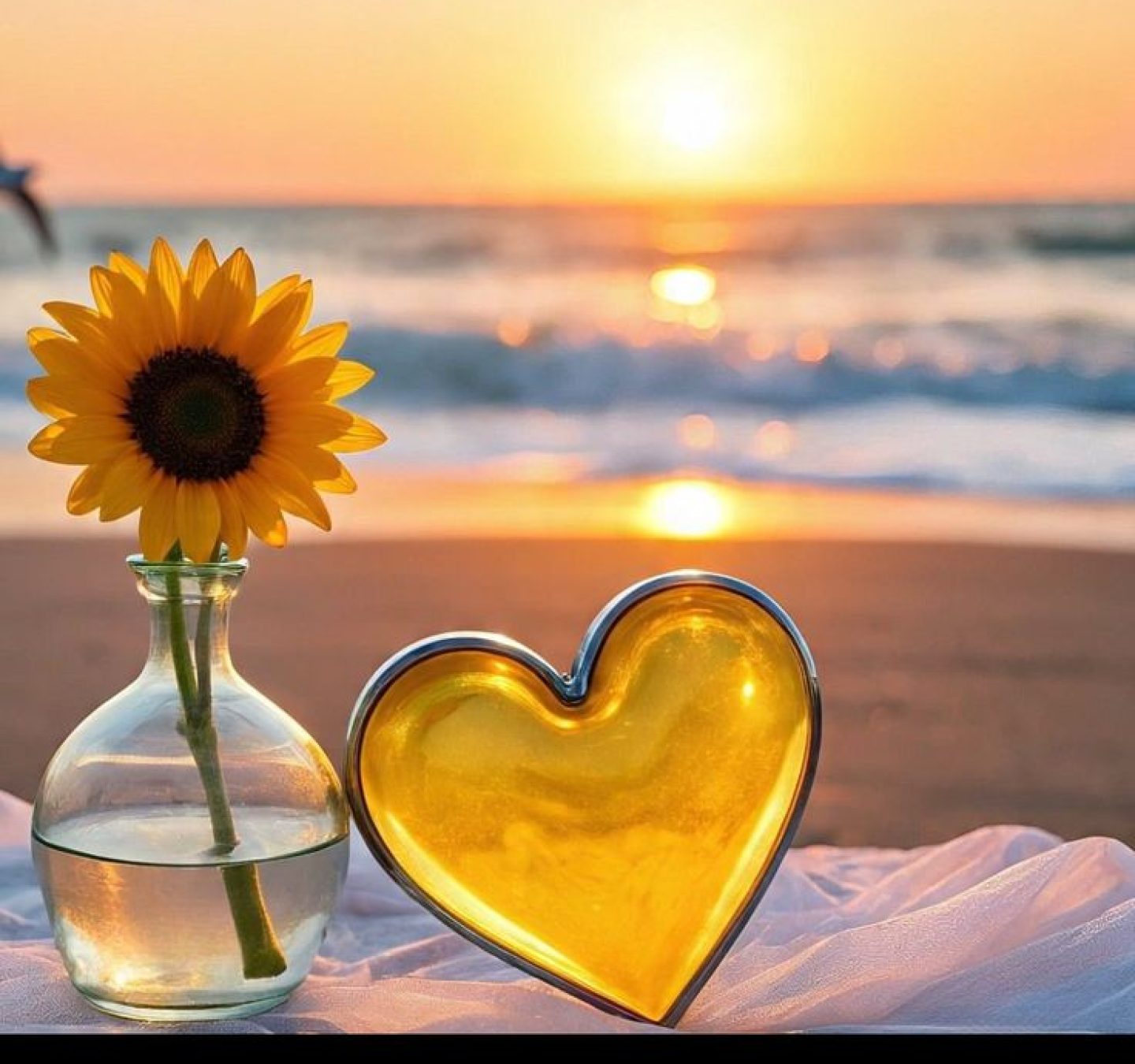
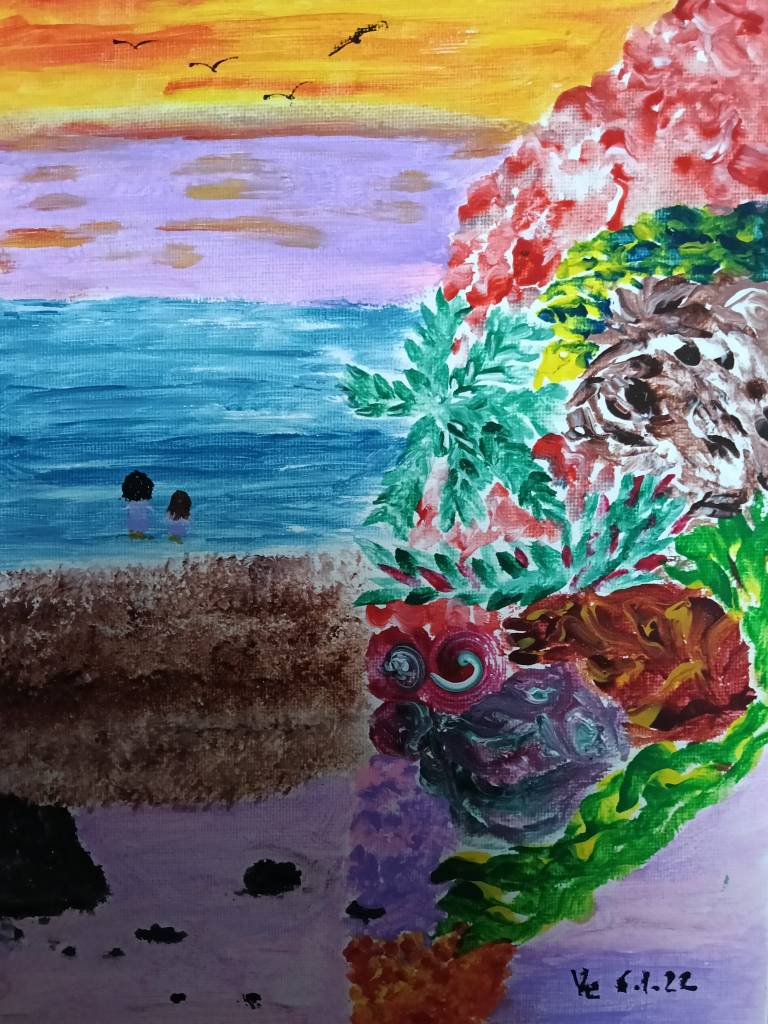
This painting has been the background of my phone since the day I painted it.
I never deliberately decided that it would stay there for so long. I simply never felt the need to replace it.
Perhaps some images remain with us because they continue to hold something we have not completely understood yet.
The painting itself still has no name.
I have thought about naming it many times, but somehow every title feels a little too small for what I was trying to express when I painted it.
At the time, I was thinking about the journey of life.
Sometimes life seems to travel across different dimensions.
We move through land, where our feet meet the tangible world.
We cross the sea, where horizons open and certainty becomes less visible.
We look towards the sky, carrying hopes, questions, imagination, and possibilities beyond what we can immediately reach.
But perhaps there is another landscape as well.
Somewhere beneath all of these visible worlds lies a much deeper place—the quiet trench at the bottom of the heart.
Like the deepest parts of the ocean, much of it remains unseen.
It carries memories, tenderness, longing, joy, pain, dreams, and parts of ourselves that perhaps even we do not completely understand.
And yet, I like to imagine that somewhere within this complicated landscape there is still something very simple:
a pure soul inhabiting a beautiful space.
Not untouched by life, but still capable of recognising beauty.
Not protected from storms, but still willing to look towards the horizon.
Perhaps that was what I was painting.
Or perhaps I am only beginning to understand it now.
For the moment, I will let the painting remain unnamed.
Some things need time before they tell us what they want to be called.
Untitled, painted 6 January 2026. Sea, land, sky—and the unseen landscapes beneath them. This painting has remained on my phone screen since the day it was created. Perhaps I am still waiting for it to tell me its name.
A Pure Soul Between Worlds
Across the land, we learn the weight of footsteps.
Across the sea, we learn to travel without knowing exactly where the horizon ends.
Across the sky, our thoughts become wings, carrying questions farther than our bodies can go.
But beneath them all there is another world—
a trench inside the heart,
deep enough to shelter forgotten dreams,
quiet enough to keep the voices we once thought had disappeared,
and wide enough to hold both joy and sorrow without asking either to leave.
Perhaps the soul lives there,
somewhere between water and earth, light and depth, memory and becoming.
And perhaps life is not about escaping from one world into another,
but learning to inhabit them all—
with tenderness,
with wonder,
and with enough courage to remain beautiful inside.
I used to think that some things happened at the wrong time.
Too early. Too late. Not according to plan. Sometimes I wondered why certain things could not have happened differently, or why particular chapters of life arrived when I was not ready for them.
Life has gradually taught me to see time differently.
Perhaps there is no perfectly “right” time against which every moment of our lives should be measured. Things happen within circumstances much larger than what we can see at that moment. Some bring joy. Some bring disappointment, separation, uncertainty, or pain. And often, their meaning only becomes visible much later.
I am still learning this.
I am learning to welcome happiness without assuming it will last forever, and to experience difficult times without believing that they define the whole journey. Acceptance does not mean that everything that happens is good, fair, or easy. It simply means recognising that what has already happened has become part of the waters through which I have travelled.
Perhaps life is a little like sailing.
We cannot command the wind. We cannot flatten the waves or ask the tide to wait until we feel ready. Sometimes we sail with confidence beneath a bright sky; sometimes we move slowly through waters we never intended to enter.
But we can continue to hold the sail.
We can learn from the wind, adjust our direction, and give meaning to the distance we have travelled.
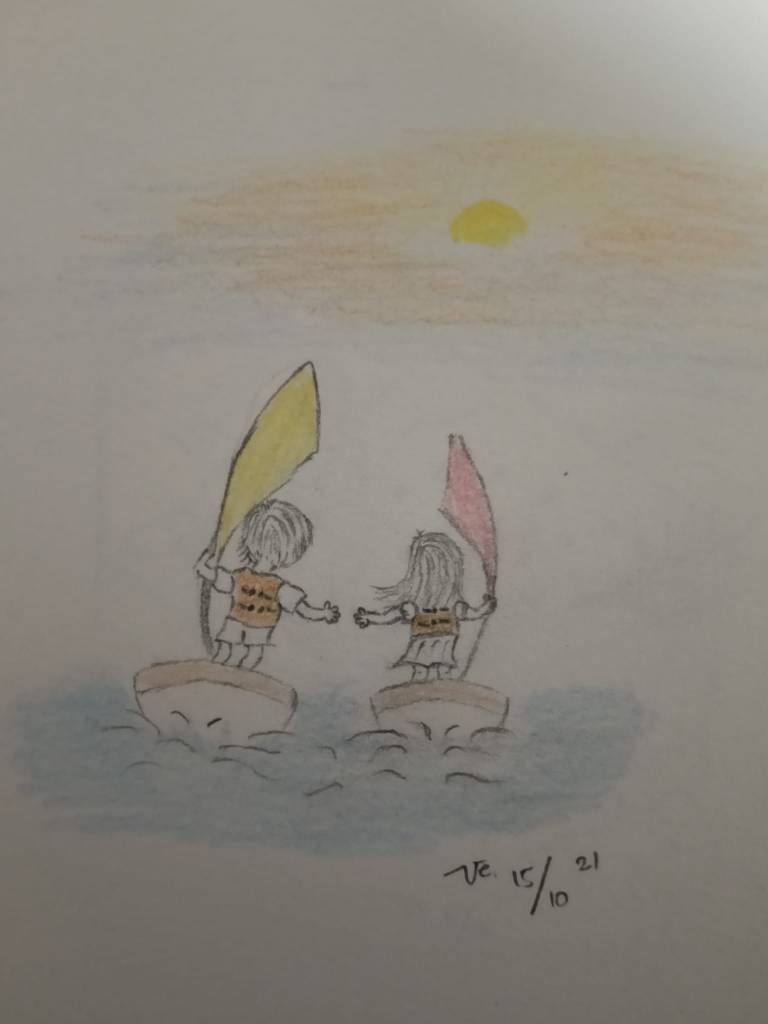
Looking at this little drawing, I think that is what I see now: two small travellers, each on their own vessel, reaching towards one another while continuing to sail.
Not every journey needs to arrive at the same shore to have meaning.
And perhaps that is one of the lessons life continues to teach me: do not blame the timing. Live the journey, learn from its waters, and allow meaning to emerge along the way.
Poem — The Time of the Tide
I will not blame the tide for coming when it came, nor ask the wind why it carried me this way.
Some waters brought me laughter, some taught me how to grieve, and some remained unanswered long after I had sailed through them.
I cannot command the ocean to follow the map inside my hands.
So I am learning to loosen my grip on when, to stop asking life to arrive exactly as I planned.
There are journeys made together, and journeys where paths divide. There are shores we reach, and shores we only see from afar.
Still, every wave leaves something— a lesson, a memory, a different way of seeing.
And if I cannot choose the wind, I can still raise my sail.
I can give meaning to the waters behind me and keep travelling towards whatever waits beyond the horizon.
Don’t ask me why I draw this way. I simply use my fingers and whatever tools are available—whatever gives me the freedom and simplicity to create.
Over time, these strokes have somehow become my signature.
I first discovered these characters during a spiritual journey, when I was imagining the feminine and masculine energies within my soul. Yet when they appeared, they also seemed to carry something much simpler: my inner child. There is joy in them, a little mischief, movement, and the sound of children giggling. Whatever form they take, their spirit has always felt positive.
Tonight, drawing them again felt a little stiff and unfamiliar. I have stopped for some time, and perhaps my fingers have forgotten some of their freedom. But that is okay. Creativity does not always need to return perfectly. Sometimes, it simply needs to return.
This time, I am giving these little sketches a different home.
Perhaps this is also part of learning how to grow my creativity and understand my own creative identity: placing it somewhere where the right frequency may find its way through a sense of alignment.
Geilstonia can be that space.
A place where I can become a little braver with art, even in a world that often makes creativity feel like another competition.
I am not here to make perfect art. I am here to keep creating.
A small commitment to the soul, one imperfect stroke at a time.
So perhaps the best way to open Geilstonia’s creativity page is simply this: